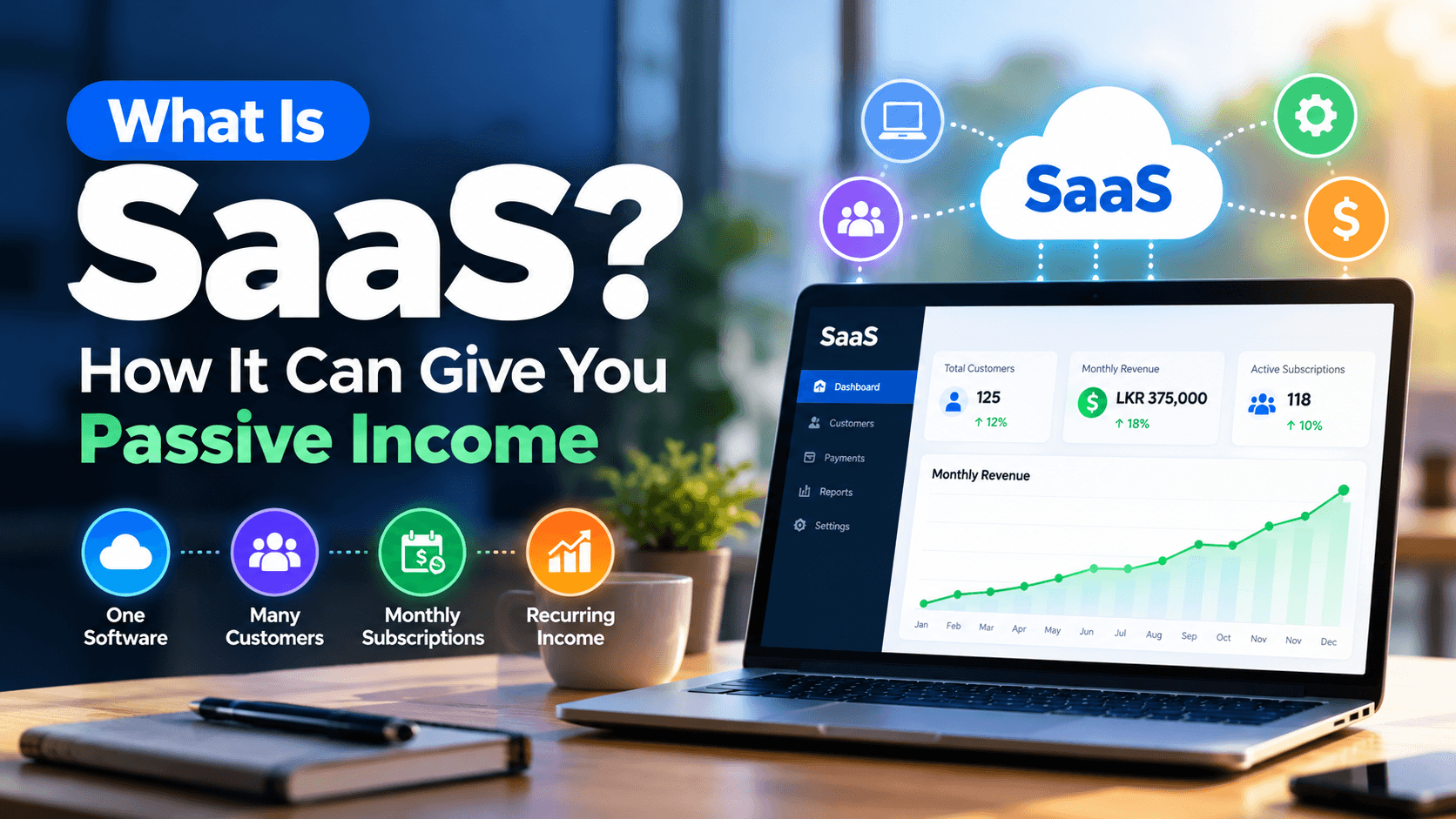
What Is SaaS? How Can Software Help You Earn Passive Income Every Month?
Imagine building a software product once and earning money from it every month. Sounds interesting, right?
That is the idea behind SaaS (Software as a Service), one of the most popular business models in today's digital world.
You don't need to own a large company, open a physical shop, or sell hundreds of products every day to build a SaaS business.
With the right idea, a useful software solution, and a reliable development partner, you can create a digital product that customers pay to use regularly.
Let's understand how it works.
1. What Is SaaS?
SaaS stands for Software as a Service.
In simple words, SaaS is software that people use through the internet, usually by paying a monthly or yearly subscription.
Instead of buying software once and installing it permanently, customers pay to access it as an ongoing service.
You probably already use SaaS products without even realizing it.
Some popular examples include:
-
Netflix: Customers pay monthly to access entertainment.
-
Canva: Businesses and individuals pay for premium design tools.
-
Shopify: Online businesses pay subscriptions to run their stores.
-
Microsoft 365: Customers pay to use productivity software and cloud services.
These businesses offer different services, but they share an important idea: customers continue paying as long as the service provides value.
That is the power of recurring revenue.
2. How Can SaaS Generate Passive Income?
Let's imagine you develop a simple appointment booking system for salons.
Your software helps salon owners manage appointments, customer details, employee schedules, and reminders.
Instead of selling the software to one salon for a one-time payment, you offer it as a subscription.
For example:
Monthly subscription: LKR 3,000 per salon
| Paying customers | Monthly revenue |
|---|---|
| 10 salons | LKR 30,000 |
| 25 salons | LKR 75,000 |
| 50 salons | LKR 150,000 |
| 100 salons | LKR 300,000 |
| 250 salons | LKR 750,000 |
Now imagine having 100 salons using your software.
You could generate LKR 300,000 every month from subscriptions.
And you don't need to develop the same software separately for each customer.
One well-designed platform can serve many businesses.
Important: These figures represent revenue, not profit. Hosting, maintenance, customer support, payment fees, marketing, taxes, and other expenses must be deducted.
SaaS is also not completely passive income. It requires ongoing management, particularly in the beginning. However, a mature and well-automated SaaS business can generate recurring income with less day-to-day involvement from its owner.
3. Why Is SaaS Different From a Traditional Software Business?
Imagine two software companies.
Company A – Traditional Software Development
A customer requests a management system. The company develops it, delivers the project, and receives LKR 300,000.
To earn another LKR 300,000, the company may need to find another customer and develop another project.
Company B – SaaS Business
The company develops one management platform and offers it to multiple customers for LKR 3,000 per month.
With 100 paying customers, the company earns LKR 300,000 in monthly recurring revenue, assuming all subscriptions remain active.
The biggest difference?
Traditional development usually depends on new projects. SaaS focuses on retaining customers and generating recurring revenue.
Both models can be profitable, but SaaS offers the potential for more predictable revenue as the customer base grows.
4. Five SaaS Business Ideas You Could Start in Sri Lanka
You don't need to build the next Facebook, WhatsApp, or Google.
Sometimes, solving one small problem for a specific group of businesses is enough.
Idea 1: Restaurant Management Software
Help restaurants manage orders, tables, inventory, billing, and daily sales.
Potential customers: Restaurants, cafés, bakeries, and takeaway businesses.
Example subscription: LKR 3,000–8,000/month.
Idea 2: Tuition Class Management System
Sri Lanka has many private tuition teachers and educational institutions.
A SaaS platform could help them manage students, attendance, fees, examination results, and parent notifications.
Potential customers: Tuition teachers, institutes, and training centres.
Example subscription: LKR 2,000–5,000/month.
Idea 3: Salon and Spa Booking Software
Build a simple platform that allows customers to book appointments online while salon owners manage staff, schedules, and customer history.
Potential customers: Salons, spas, and beauty centres.
Example subscription: LKR 2,500–6,000/month.
Idea 4: Small Business Inventory and Billing Software
Many small shops still manage stock and sales using notebooks or spreadsheets.
A cloud-based system could help them track products, create invoices, monitor stock levels, and view sales reports.
Potential customers: Retail shops, grocery stores, fashion boutiques, and wholesalers.
Example subscription: LKR 3,000–10,000/month.
Idea 5: Property and Rental Management Software
Create a system that helps property owners manage tenants, rental payments, agreements, and maintenance requests.
Potential customers: Landlords, property managers, and rental agencies.
Example subscription: LKR 2,000–7,000/month.
All subscription prices above are illustrative business-model examples, not verified market prices.
5. Do You Need Programming Knowledge to Own a SaaS Business?
No. You don't necessarily need to be a programmer to own a SaaS product.
Just as you can own a restaurant without being a chef, you can own a software business without personally writing code.
However, you need three important things:
-
A real problem to solve. Find something businesses struggle with and would pay to fix.
-
A reliable development partner. Work with experienced developers who understand software architecture, security, scalability, and maintenance.
-
A business plan. Know who your customers are, how much they can afford, and how you will attract and retain them.
Today, artificial intelligence can help accelerate software development.
But remember: AI can help build software. It cannot guarantee a successful software business.
A professional SaaS platform still needs proper planning, secure development, testing, reliable hosting, payment integration, and ongoing support.
6. How Much Does It Cost to Build a SaaS Product?
The development cost depends on the complexity of your idea.
A simple booking system is very different from a complete accounting or enterprise management platform.
Your investment may include:
-
UI/UX design and software development
-
Cloud hosting and database services
-
Domain name and security
-
Payment gateway integration
-
Testing and maintenance
-
Marketing and customer acquisition
You don't always need to develop every feature immediately.
A smarter approach is to start with an MVP (Minimum Viable Product).
An MVP is a basic but functional version of your software that solves the main customer problem.
For example, instead of building a salon platform with 30 features, you might start with appointment booking, customer management, and notifications.
Launch it, collect feedback from real users, and improve the product gradually.
This approach can reduce your initial investment and help you avoid spending money on features customers don't need.
7. Can SaaS Really Become Passive Income?
Yes, SaaS can become a source of relatively passive, recurring income, but it takes time and effort.
In the beginning, you may need to work actively on development, sales, marketing, customer support, and improvements.
As your business grows, you can automate many processes, including:
-
Customer registration and onboarding
-
Subscription payments and renewals
-
Invoice generation
-
Account activation
-
Customer notifications
-
Backups and routine monitoring
With a stable platform and efficient processes, your business can serve customers continuously, even when you are not personally working.
However, customers may cancel subscriptions, technical issues may occur, and competitors may enter the market.
The real goal is not to make money without doing anything. It is to build a business that earns recurring revenue without requiring your constant personal involvement.
8. How to Start Your First SaaS Business
Here is a practical approach.
Step 1: Identify a problem
Speak with local business owners. Find out what tasks consume their time or cause repeated difficulties.
Step 2: Validate your idea
Before investing heavily, ask potential customers whether they would actually pay for your solution. Try to secure a few pilot customers.
Step 3: Choose a subscription model
Decide whether to charge monthly, yearly, per user, or based on usage.
Step 4: Build a small but reliable product
Focus on essential features, security, usability, and performance.
Step 5: Launch with a small group of customers
Start with five or ten businesses. Learn from their feedback before expanding.
Step 6: Improve and scale
Once your customers are satisfied and your pricing covers the cost of serving them, invest in marketing, automation, and additional features.
Remember, 100 satisfied paying customers are more valuable than 1,000 users who never pay.
9. Why Choose Apps Lanka for SaaS Development?
At Apps Lanka, we believe successful software is not simply about writing code.
It is about understanding business problems and developing technology that creates long-term value.
Our development experience has evolved through multiple generations of technology, from native mobile application development to modern cross-platform solutions using Flutter, cloud-based platforms, and AI-assisted development.
This experience helps us understand not only how to develop software, but also how to plan for future growth, maintenance, security, and scalability.
Whether you are an entrepreneur with a new SaaS idea or an established business planning to turn an internal system into a subscription product, we can help you explore the technical possibilities.
Our approach focuses on building software that can grow with your business, rather than creating something that only looks impressive during a demonstration.
10. Final Thoughts: Stop Thinking Only About Selling Software Once
The SaaS business model creates an opportunity for entrepreneurs to turn useful software into a long-term digital business.
You don't need millions of customers.
You need the right problem, the right solution, a sustainable subscription price, and customers who continue receiving value.
Imagine starting with just 10 paying businesses, growing to 50, and eventually reaching 100 or more.
That is how a small software idea can develop into a meaningful recurring-revenue business.
Your next business opportunity might not be a physical product. It could be a simple software solution that hundreds of businesses need every day.
Have a SaaS Idea? Let's Build It Together.
At Apps Lanka, we help businesses and entrepreneurs transform ideas into scalable web applications, mobile applications, and cloud-based software solutions.
Whether you have a complete business plan or just an idea, the first step is understanding what you want to build and whether customers will pay for it.
Let's turn your software idea into a real business opportunity.
Apps Lanka — Software Development, Mobile Applications & SaaS Solutions.


0 Comments